
If systems aren’t designed for people, who are they really designed for?
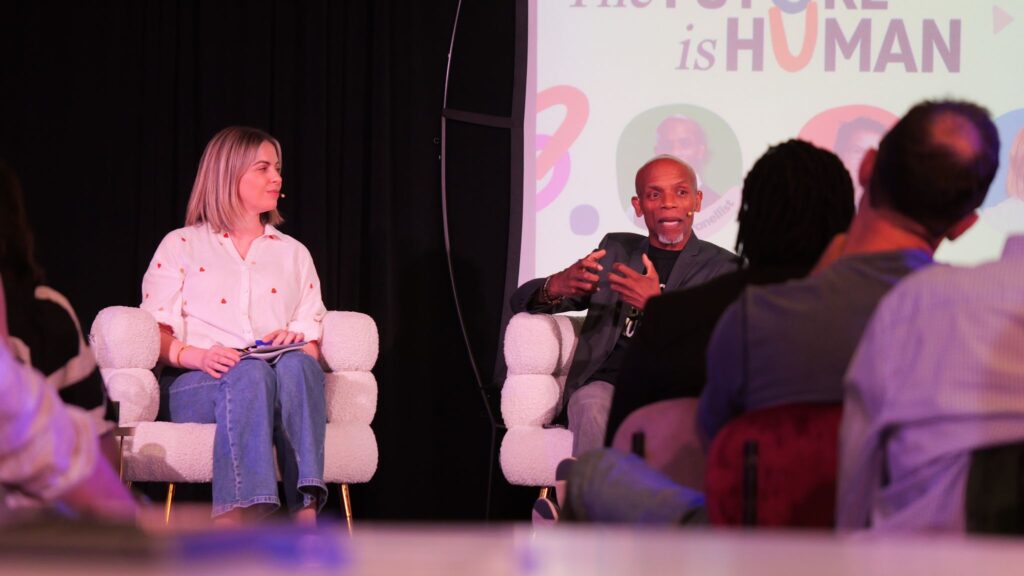
This was one of the major themes underpinning The Future is Human: Co-design to Coexist, a recent gathering of minds hosted by The LOTE Agency in partnership with Portable. This wasn’t your typical panel discussion. The audience was invited to shape the discussion, rather than be spectators to a pre-scripted conversation. The panel had no fixed agenda or end game – instead, the event was an invitation for everyone in the room to reimagine leadership, culture, and systems on their terms.
The conversation was led by Kathryn Foster, organisational psychologist and Portable’s Head of People and Culture, bringing together three distinct voices;
Reggie Butler, US-based leadership coach and founder of Performance Paradigm, who challenges perspectives through human-centered storytelling.
Jon Yeo, TEDxMelbourne curator and leadership communication expert, whose work is grounded in building meaningful communities of practice to create innovative and equitable systems.
Bella Borello, Head of Social Impact & Engagement at The LOTE Agency, who champions inclusive strategy and storytelling for social change.
The discussion was broad, ranging from the philosophical to the practical, leaving the audience with many insights into what it actually means to design services and systems that put people first. This article highlights the key points and quotes that really drove home the need to design for coexistence over compliance.
Busting the Illusion of Merit
At the core of many workplace cultures sits an idea that seems logical on a surface level—the concept of meritocracy, the belief that talent and effort alone determine success. Reggie reminded us that meritocracy has come miles away from its original intent, which was satire. “It was never meant to be aspirational, but a critique of an unfair system“, he states. That critique still seems to hold. When we ignore the unequal starting points that shape opportunity, we reinforce systems that reward familiarity over fairness. Bella added to this concept the fact that inclusion calls us to redefine success.
Who defines the merit? And by whose standards?” -Bella Borello
Rather than pushing everyone into the same mould, Jon Yeo offered a new metaphor: “We need to shape people like bonsais—thoughtfully, with attention to each individual’s context.” In other words, we need to nurture potential over standardising success.
Inclusion Isn’t an Acronym
Today, the rhetoric around inclusion seems to be everywhere, from corporate strategies to conference panels and recent headline news. And yet, as Bella pointed out, it’s starting to lose its true meaning. “The branding person in me wants to rebrand DEI entirely. It’s become jargon. What we’re really talking about is people.”
The reminder to centre the human before the headline was echoed by Reggie, who stated;
The work (DEI) was happening long before we gave it a label, and it will still be happening when the current acronym disappears. -Reggie
When inclusion is treated as a campaign or compliance measure, it misses the point. True inclusion must be embedded in how we lead, hire, communicate, and design in every interaction.
Inclusion isn’t New
We often talk about human-centred design as if it’s a new concept. Yet Reggie highlighted how; “Civilisations were founded on human-centred design. Communities have always come together to survive.” The issue isn’t that we don’t know how to design for each other, it’s that many of our current systems were never built with equity in mind.
Bella agreed, noting that as a society we’ve had to start reminding people to actually design for the end user. Jon added: “It’s hard to apply human-centred design in systems that weren’t built to be human-centred—like capitalism or bureaucracy. But that’s where the work begins.”
That’s the irony. We’ve drifted so far, we have to reframe empathy as innovation. -Bella
From Listening to Co-Authoring
Inclusion often stops at consultation. But listening without sharing decision-making is not co-design—it’s containment.
If you’re not designing with the people the change affects, you’re not designing for them. You’re guessing. -Bella
True co-design means communities help shape the process, not just providing superficial feedback at the start or end of the process. And that can be messy. It requires active listening, embracing mistakes, and actually caring about the best outcome for the community. Jon emphasises how sometimes inclusion means navigating competing needs.
Sometimes what supports one group may challenge another. That’s where nuance, dialogue, and design come in. -Jon
Stop Trying to Boil the Ocean—Warm the Water Around You
Big change can feel overwhelming. But as Reggie reminded us; “Do what you can, where you are. Culture changes through small, consistent actions.”
Rather than aiming to fix everything, we can start by examining our surroundings. What are our assumptions, defaults, and habits? Who do the systems in our daily lives truly serve? Each conversation, policy change, or community project is a chance to shift cultures from within.
Inclusion isn’t something extra. It should be in the moments—the everyday decisions and interactions that shape cultures. -Bella
So, What Does It Mean to Design for Coexistence?
It means building systems that don’t just create a means to an end but rather work for more of us. It means valuing lived experience, emotional intelligence, and cultural experiences —not just efficiency and expertise. As Jon touched on during the panel session, unconscious bias can be an access point to a deeper understanding. By acknowledging unconscious bias, we are giving a voice to the subcultures and mindsets that previously may not have been recognised or heard. Ultimatley, designing for coexistence means refusing to treat inclusion as a problem to solve and seeing it instead as a design advantage.
Ready to Rethink Inclusion?
We help leaders move from intention to impact. Let’s build the next version of your organisation, together.
The LOTE Agency is a certified social enterprise dedicated to building inclusive experiences through human-centered design, research and strategy.
Portable is a certified B-Corp leading the way forward for positive impact through the intersection of design and technology.
Lets partner for purpose. Contact us below to register for our next event in the Future is Human series and to find out how we can work together to co-create brighter futures.
